
Raw honey, oat and almond flapjack bites
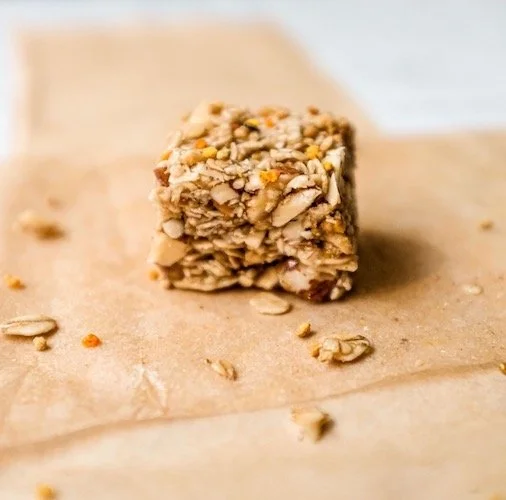
Image by stillmotionarts
These petit-four sized honey bombs are bursting with flavour, have a delightfully nobbly texture, won’t mess with your blood sugar and are even great for your gut health. Probiotic and prebiotic, they seed your gut with beneficial microbes and feed the ones you already have.
No-bake, they’re super-quick and easy. Just melt the cultured butter (gently, to preserve its beneficial live bacteria) and cacao butter, stir everything together, press into a baking tin, chill, cut and serve!
Perfect to end a meal, with coffee, for lunch boxes or healthy snacking.
Want to be the first to hear about my upcoming book?
How to Eat for Wellbeing & Joy – the healthy eating cookbook for foodies
A celebration of your local raw honey: A honey snapshot of time and place
I first made these flapjacks to showcase my local raw honey: Graeme’s Glasgow Honey (formerly Ed’s Bees), urban honey from hives dotted across Glasgow’s green spaces, rooftops and treetops. Honey in its purest state, the flavour of raw honey will blow you away. Completely unheated, unpasteurised and unfiltered, its remarkable intensity and complexity is totally unrecognisable from the unidimensional, bland sweetness of blended, boiled and ultra-filtered commercial honeys.
Each mouthful bursts with florals, nuanced sweetness and warm depths. A honey snapshot of time and place, the very best raw honeys are often from a single hive, uniquely expressing the flowers that were in bloom around that specific hive at a specific point in time. A different time of year, a different hive, and the honey is completely different. My own jar, from the Royal Hive of Queen Mabel of Pollokshields, is a thing of buttery, caramel beauty, with soft woody undertones (rosewood comes to mind).
I’ve opted for a raw (no-bake) flapjack to retain the honey’s incredible perfume and mouth-filling flavour, the probiotic bacteria in the cultured butter (great for your gut) and the resistant starch in the oats (great for your blood sugar and gut), all of which would be cooked off with heat. You also get a lovely jumble of rough-hewn, open, moist texture versus the hard, compact crumb of cooked flapjacks.
Bee pollen amps up the goodness and honeybee oomph factor, adding a slightly woody, pleasantly bitter catch that works beautifully against the honey’s rounded sweetness.
The quality of ingredients and sheer intensity of flavour mean you don’t need much – just one or two is enough to satisfy, won’t spike your blood sugar, and can even be enjoyed on a low-GI, low-carb or keto diet (yes, really! 9g net carbs a pop).
What’s great about it
Blood sugar friendly for a sweet treat: No added sugar. Naturally sweetened with honey only and rich in fibre and resistant starch, slowing digestion and the release of its sugars into your bloodstream.
A good source of fibre: 5.7g/100g.
Prebiotic: From the oats, honey and almonds. Raw oats are rich in resistant starch (around 10g/100g, almost all destroyed by cooking), a type of starch that resists digestion and acts like fibre, fuelling the beneficial bacteria in your gut. Honey contributes prebiotic oligosaccharides, non-digestible complex sugars, while the almonds add soluble fibre and polyphenols.
Probiotic: So long as you heat it gently, the cultured butter adds a bonus dose of beneficial live bacteria.
Honey is antimicrobial, antioxidant and anti-inflammatory.
How many of your ≥5-A-Day: 0 per serving
Plant points: 3
Prep: 15 minutes
Cooking: 2-3 minutes
Tin sizes & servings
As we eat with our eyes first, our goal is a batch of the prettiest, perfectly equal, dainty squares. A square tin makes that easy peasy and is therefore the ideal option, but I’ve also given rectangular dimensions in case you don’t have one.
4-inch/10cm square tin (makes 9 petit-four sized squares)
Or any rectangular tin measuring approximately 16 square inches/103cm².
As I’m only catering for two, this is my default size. If you’re making for more, just scale up as follows.
5-inch/13cm square tin (makes 16 petit-four sized squares)
Or any rectangular tin measuring approximately 25 square inches/161cm².
Multiply the ingredient quantities by 1.5 (i.e. add half again).
6-inch/15cm square tin (makes 25 petit-four sized squares)
Or any rectangular tin measuring approximately 36 square inches/232cm².
Simply double the ingredient quantities.
Ingredients (makes 9 petit-four sized squares)
Wet:
50g any excellent raw honey local to you (e.g. Graeme’s Glasgow Honey), choose a runny one so you don’t need to heat it to mix
35g raw cultured grass-fed salted* butter, cubed (e.g. Bungay Raw Butter or Isigny Ste Mère Unpastuerised Salted Butter, recommended in that order – see Recommended Products & Stockists below for details; see Variations for dairy-free sub)
15g organic unrefined cacao butter (any top quality brand, see suggestions below)
Dry:
50g organic standard rolled oats**
20g organic jumbo rolled oats**
25g organic whole almonds, sliced finely
25g organic flaked almonds, toasted
10g/1 tablespoon organic bee pollen granules, plus extra to finish (e.g. Al-Ameen)
*Salt accentuates sweetness and makes flavours POP. It is needed in this recipe, so if you use an unsalted butter, add it back in with ⅛ teaspoon finely ground salt.
**If you follow a gluten-free diet, opt for a brand that’s labelled gluten-free.
A word of caution: Stick to the amounts exactly
For me, the nobblier a flapjack the better. If I could make one with all jumbo oats I would. Sadly, standard rolled oats are needed to soak up the wet ingredients and bind everything together (too many jumbo oats > wet granola ☹️). I’ve played around with different ratios of each and the above amounts give optimum nobbliness for cohesion. There is no margin for error – just 10g more jumbo oats instead of standard won’t set up enough to cut, so this is one recipe to stick to the amounts exactly. The whole almonds must be sliced relatively finely for the same reason – while nobbly eats beautifully, cutting becomes tricky as the edges disintegrate.
Method
Preheat the oven to 160C.
Place the flaked almonds on a baking tray and roast until an even light golden, checking at 6 minutes and giving 1 or 2 minutes extra if necessary. Set aside to cool.
While the almonds are cooking and cooling, line your tin and prep all the dry ingredients.
Line a 4-inch/10cm square baking tin with baking paper (see above note on alternative tin sizes and amounts). Cut two lengths of paper the width of the tin, looping each length up and over the sides of the tin so it’s easy to lift out the set flapjack.
Place the whole almonds on a chopping board and slice finely – too chunky and the squares won’t cut cleanly.
Transfer the sliced almonds to a mixing bowl and add the rolled oats, jumbo oats and bee pollen. Once they’re completely cool, add the flaked almonds and stir everything together until evenly combined, using a fork so as not the break the flaked almonds.
Cube the butter. If using block or shards of cacao butter rather than pistoles, chop it into pieces too. Add both to a small saucepan, place on the very lowest heat and warm gently until almost melted, stirring continuously. Remove from the heat and continue stirring until fully melted; the residual heat of the pan will melt the rest. (Alternatively, if you have a dehydrator, place the butter and cacao butter in a small bowl, pop inside and heat at 40°C until just melted.)
Important note: Heating the fats until they’re just melted and no more (32-35°C) maximises goodness and flavour, preserving the butter’s probiotics and the cacao’s beautiful heady aromas. Above 40-45°C, the butter’s beneficial live bacteria start dying off and you start to lose the cacao butter’s delicate volatile aromatic compounds (the white-chocolatey notes). Minimal gentle heat is key.
Add the honey to the melted butter and cacao butter and stir to combine. Pour the wet mixture over the dry ingredients and stir until everything is evenly combined.
Tip the mixture into the prepared tin, then press it down very firmly with the back of a metal spoon or a spatula.
Next – and this step is absolutely crucial, to both the texture and cutability – choose something with a smooth flat base (a small jar for example, I use the end of a plastic rolling pin), and pack the mixture down, pressing down hard until it’s as compact as you can get. Finally, run the jar/rolling pin/whatever implement you’re using across the top, going from side to side then front to back, to create a perfectly level surface. If your smoother doesn’t have straight sides, it won’t reach the edges, in which case go back in with the spoon/spatula to even them off.
Sprinkle the surface lightly with extra bee pollen – not too much, especially if you’re not keen on bitter.
Place the tin in the fridge for 3-4 hours, preferably overnight, for the flapjack to set up.
Turn the flapjack slab out onto a chopping board. Mark out the top into 9 even petit-four sized squares (or 16 or 25 for the larger tins), scoring it with a knife, then cut along the guide lines. For pro, super-sharp clean edges, use a sharp bread knife, run it under a very hot tap (or dip into a tall jug of boiling water) and dry with a clean tea towel in between each slice.
Store in the fridge for up to one week. They also freeze very well (up to 3 months).
For maximum sweetness, flavour and a crumbly, more open texture, allow the bites to come up to room temperature before serving – our taste receptors for sweet, umami and bitter work best at temperatures of 15-35°C. See my article How Temperature Affects Taste for more info. Alternatively, serve cold if you prefer a firm, dense, chewier texture.
Recommended products & stockists
For the very best raw honey, look for passionate, small-scale beekeepers and artisan producers at your local farmers’ market and indie shops. Or go direct to the beekeeper. For max time and place expression, look for single-hive (totally unblended) or single apiary (minimally blended) honeys. Graeme’s Glasgow Honey (formerly Ed’s Bees) is available from George Mewes Cheese (delivery nationwide) Starter Culture (delivery across mainland UK), Locavore and The Honeybee Bakery.
Bungay Raw Butter – the best butter I’ve ever tasted. One of a handful of raw milk cultured butters made in the UK, produced by Fen Farm Dairy in Suffolk from their own herd of grass-fed, ancient-breed (Montbeliarde) cows. Rich, fully-flavoured and complex – once you’ve tried it, all other butters pale by comparison. Totally worth the splurge. Available locally from Mellis and online from the dairy’s shop.
Isigny Ste Mère’s Unpastuerised Salted Butter – a raw milk cultured butter from grass-fed cows in the Isigny-Ste-Mère Protected Designation of Origin (PDO) region of Normandy, the champagne of French butter-making. My everyday go-to butter. Available from Waitrose and Sainsburys.
Check specialist health food shops, local independents or online retailers for great quality cacao butter. Sadly, my long-time favourites seem to have gone to the wall – Seed Chocolate’s majestic Organic Unrefined Cacao Butter (made from the rare Criollo bean, the ‘King of Cacao’) and Choc Chick’s Organic Cacao Butter. Locally, Locavore stocks the Raw Chocolate Company Organic Cacao Butter Buttons (£5.73 for 200g) and Natural Balance carries Organic Traditions Cacao Butter (£7.99 for 200g).
Al-Ameen organic bee pollen is available locally from Roots, Fruits & Organics.
Variations
Dairy-free adaptation: This recipe is a celebration of the flavour of outstanding honey and butter. If you can eat butter, I therefore strongly urge you to try the original recipe, using the very best butter you can get your hands on. However, if butter is a dietary no-go, or just not your thing, replace it with 25g cashew butter (e.g. Biona organic), increase the cacao butter to 25g (because nut butter is softer than butter, you need extra for it to set), and add 1/8th teaspoon finely ground salt. The result is exceptionally good.
If you prefer a firmer flapjack, you can increase the standard rolled oats to 60g (keeping the jumbo at 20g). Personally, I prefer 50g, for a more open-textured flapjack, greater honey intensity and lower carbs, but 60g also works.
Serving suggestions
As petit fours.
With a morning or afternoon cuppa.
Great for packed lunch boxes and healthy snacking.
Also rather lovely crumbled over natural yoghurt or kefir with stewed apples. For breakfast or pudding. An indulgent take on granola.